International scientists call for urgent research into Antarctica’s last great unknown
30 September 2026
A region of Antarctica with one of the greatest potential contributions to reshape the natural world and human society is also the least scientifically understood and explored.
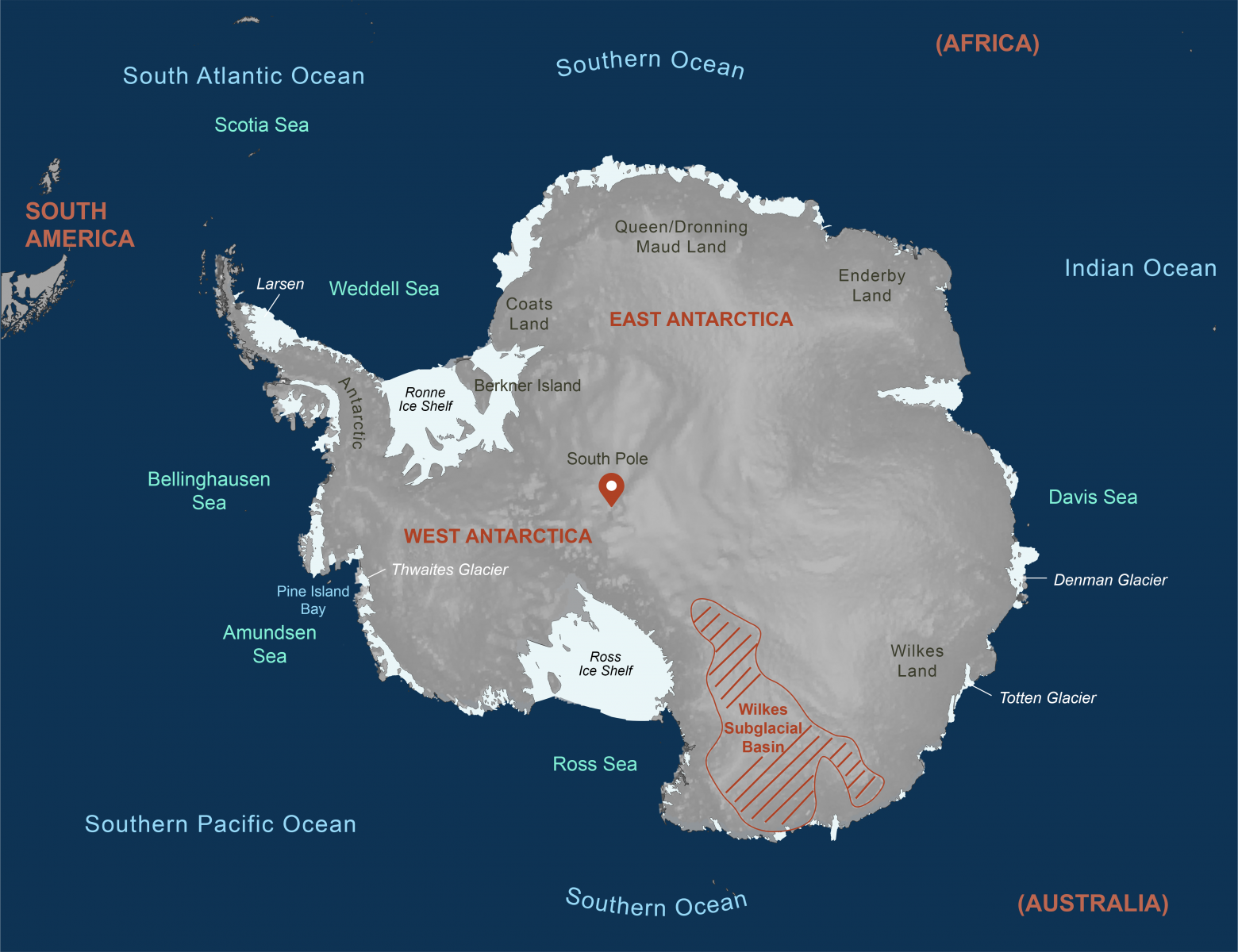
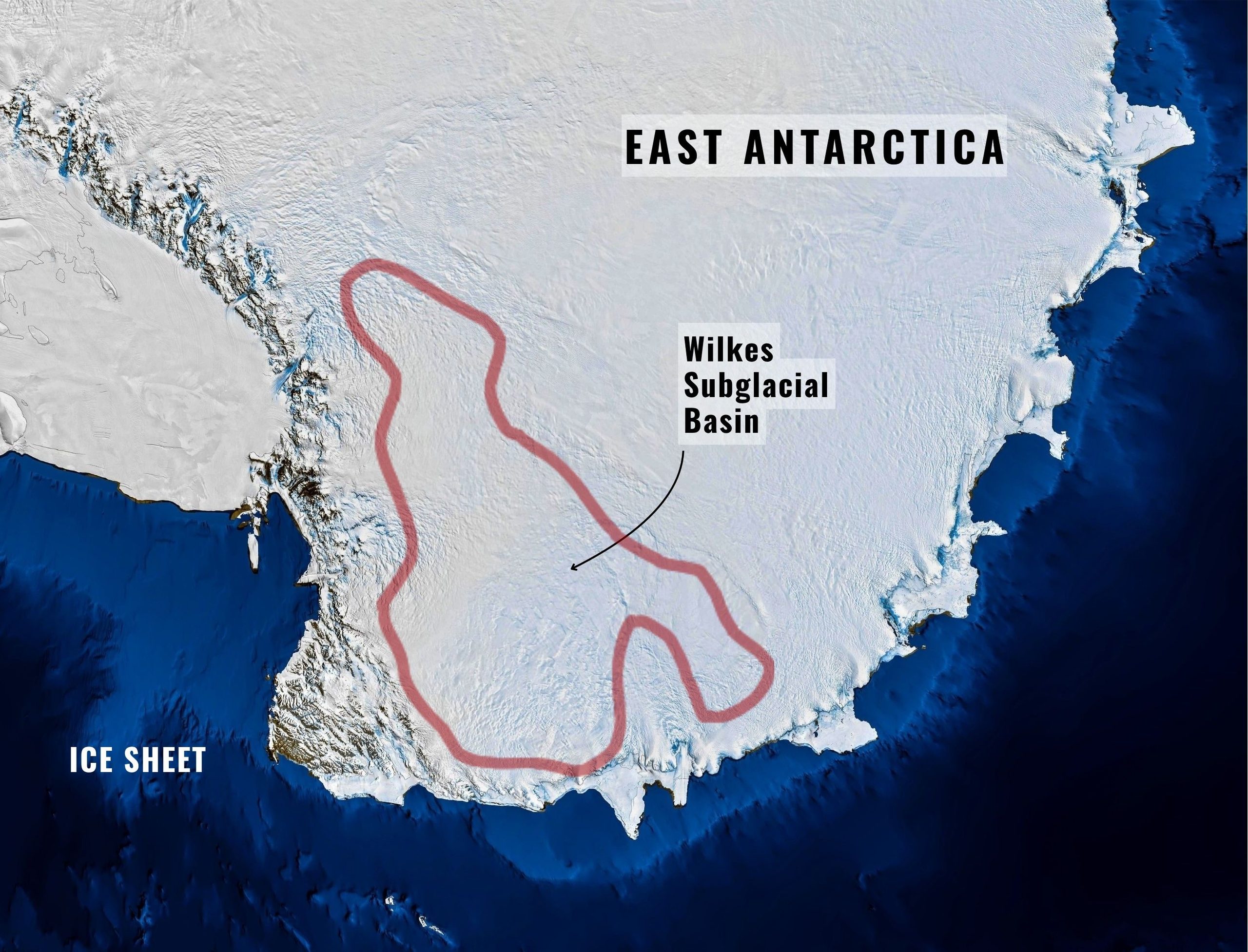
A major new global review paper is calling for a coordinated global campaign to study East Antarctica’s Wilkes Subglacial Basin, one of the most important regions on Earth for predicting future sea-level rise, containing enough ice to raise global mean sea levels by an estimated three to four metres.
Led by Australian Centre for Excellence in Antarctic Science (ACEAS) Chief Investigator, Professor Matt King from the University of Tasmania, the review synthesises findings from geology, oceanography, climate science, satellite observations and ice-sheet modelling to assess what scientists know, and don’t know, about the vast ice-filled basin.
Published today in Nature Reviews Earth & Environment, the review concludes that while the basin has the potential to contribute significantly to future sea-level rise, major gaps in observations mean scientists still cannot confidently predict how rapidly change could occur or what climate thresholds might trigger large-scale retreat.
“The Wilkes Subglacial Basin is arguably the last unexplored place in Antarctica,” Professor King said.
“No ship has ever been within 150 kilometres of the front of one of the key glaciers, the Cook Glacier. There’s no in situ mapping data of the sea floor, and we have very limited information about the ocean conditions that could drive future melting.”
“Despite this region being a large part of Australian Antarctic Territory, I don’t know anyone who’s ever been there. The absence of information, even the most basic information, is really concerning.”
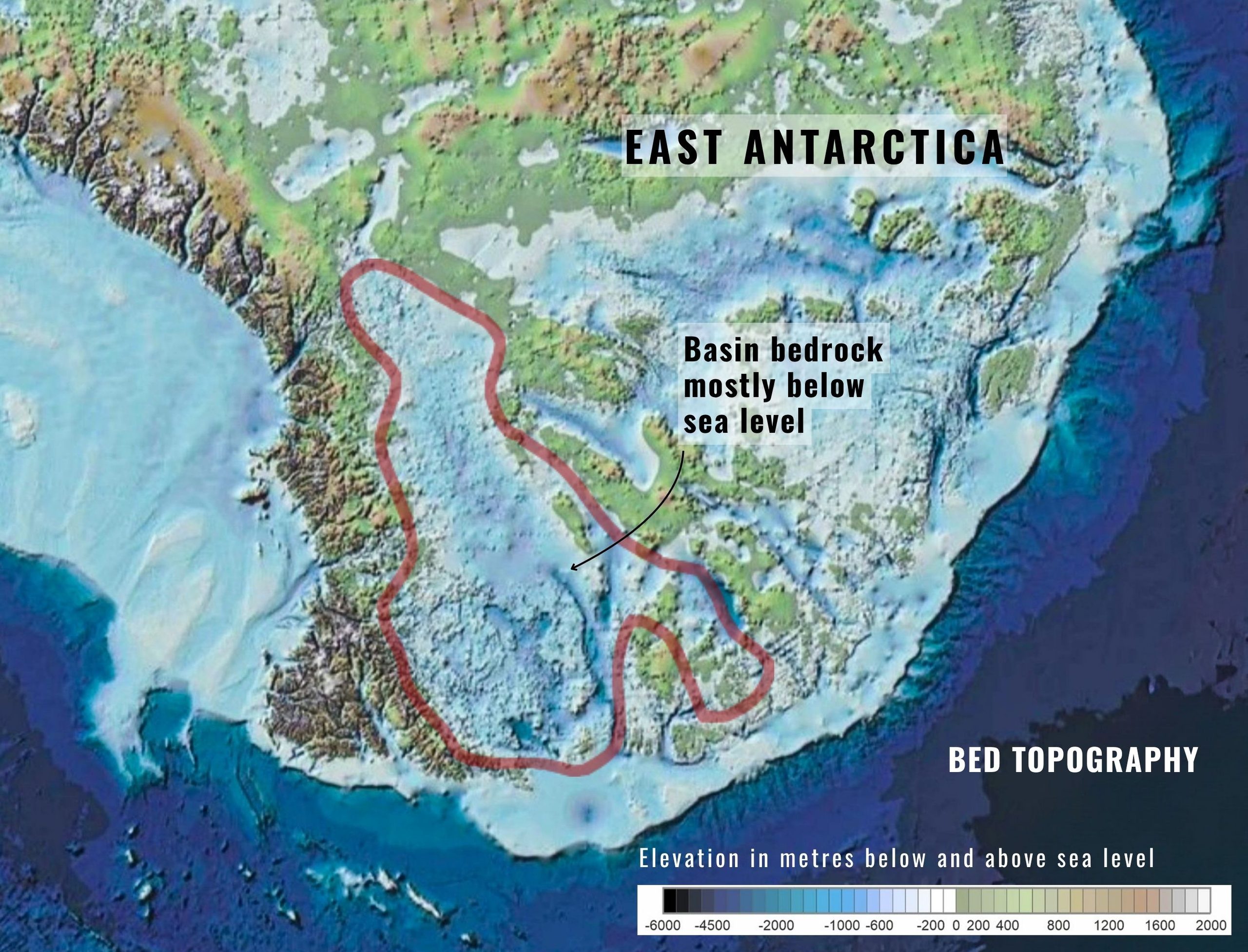
What the review found, in a nutshell
The paper was co-authored by researchers from 14 countries and calls for an urgent international response to map the region, improve ocean and ice-sheet observations, and reduce uncertainty about its future climate and sea-level impacts.
“While there is broad scientific agreement that the basin has the potential to change under future warming, we still don’t know how quickly change could occur, what climate thresholds may trigger large-scale retreat and how much the basin may ultimately contribute to future sea-level rise,” said the paper’s second author, Professor Nancy Bertler from Victoria University of Wellington, and Earth Sciences New Zealand.
One of the review’s key conclusions is that these uncertainties stem largely from a lack of observations rather than a lack of scientific interest. Scientists need data to answer some of the most basic questions: is warm ocean water already reaching the glaciers? How is the ocean changing? What does the continental shelf look like beneath the sea ice? Under what climate conditions did retreat last occur?
A climate risk hidden beneath the ice in East Antarctica
For decades, East Antarctica was largely viewed as stable, while scientific attention focused on the more vulnerable West Antarctic Ice Sheet.
That picture has changed.
The area of the Wilkes Subglacial Basin is roughly 1400 kilometres by 400 kilometres, with its ice sheet sitting on bedrock much of which is deeper than 2,000 metres below sea level. These characteristics could make the ice sheet vulnerable to ocean-driven melting and self-sustaining retreat. Scientists are particularly interested in the shape of the landscape hidden beneath the ice.
“When you have a situation where the bedrock gets deeper as you go inland, that can present a scenario where the ice sheet keeps retreating on its own, even after the initial trigger has passed,” explained paper co-author Dr Chen Zhao from the Australian Antarctic Program Partnership and ACEAS.
“Warm seawater increasingly coming in contact with and melting the ice sheet from below could lead to accelerated and potentially unstoppable ice loss on a massive scale. It’s all downhill from there.”
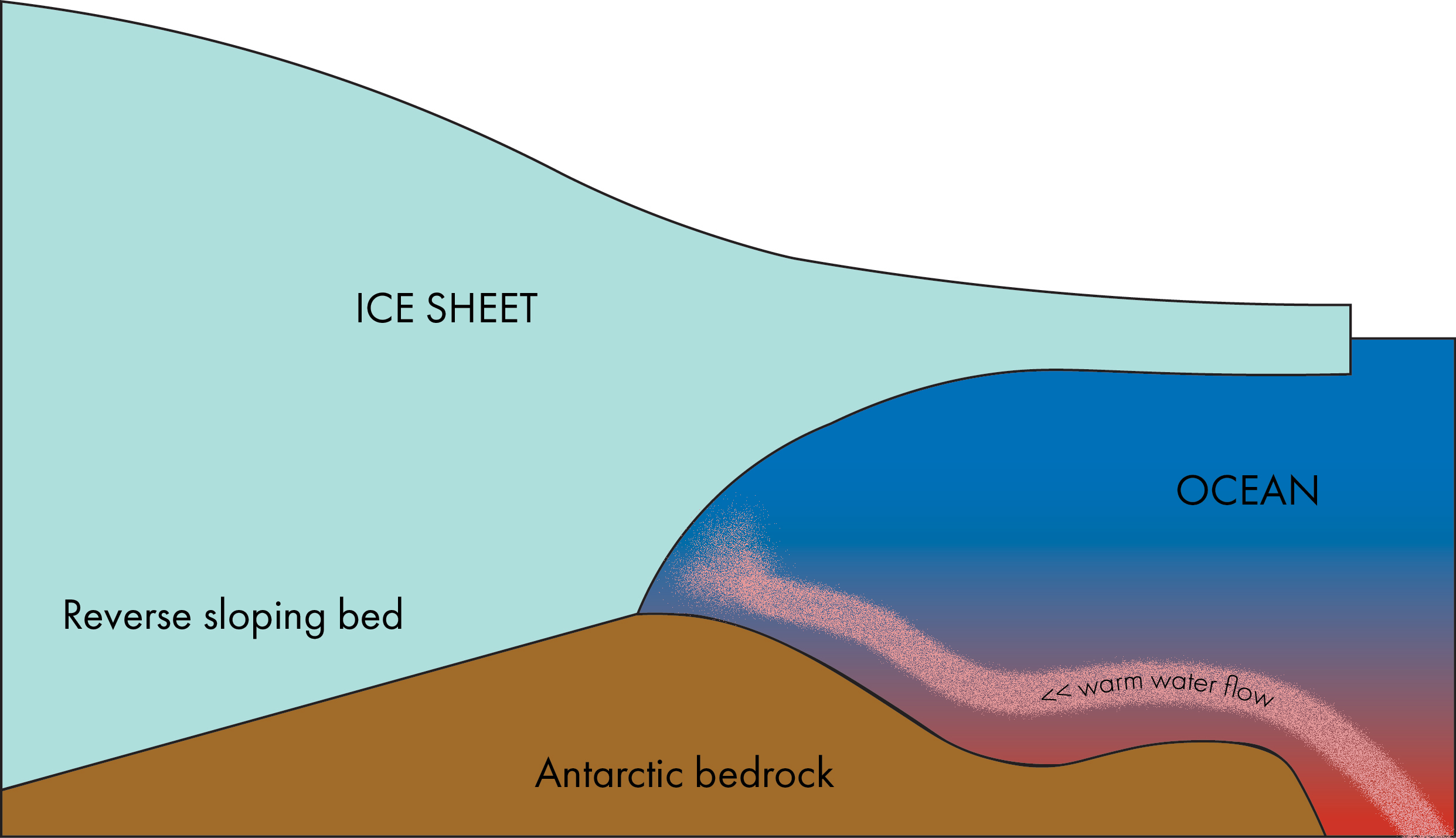
This process, known as marine ice-sheet instability, has long been a concern in parts of West Antarctica. Researchers now recognise that major regions of East Antarctica share similar characteristics.
“Starting about 10 or 15 years ago, there was a realisation that much more of East Antarctica was sitting on bedrock below sea level,” Dr Zhao said. “The ocean is the great enemy of the ice.”
Looking to the past for answers
One of the review’s strongest findings comes from evidence preserved in geological records from previous warm periods in Earth’s history.
During the mid-Pliocene, around three million years ago, global temperatures and atmospheric carbon dioxide concentrations were higher than pre-industrial levels.
Marine sediment records and modelling studies suggest parts of the Wilkes Subglacial Basin may have undergone substantial retreat during this period.
Scientists caution that past climates are not perfect analogues for the future, but they can provide important clues.
“Past warm periods give us a potential to ask how the region behaved when the Earth’s climate was warmer than present,” Professor Bertler said.
“The evidence is strong enough to raise a clear warning sign. It highlights the need for a much deeper understanding of how this region will respond to future warming.”
Fortunately, there are ways to find clearer answers, said paper co-author Professor Andrew Mackintosh from Securing Antarctica’s Environmental Future at Monash University.
“By drilling deep into the Wilkes Subglacial Basin for rock and sediments buried beneath the ice, we should be able to find out how the ice sheet responded to climates similar to those of today and those projected into the future,” he explained.
Why Australia should care
For Australians, the importance of the Wilkes Subglacial Basin is not just scientific, it is both one of Australia’s closest Antarctic neighbours and one of its least understood.
“It’s actually the closest bit of Antarctica to Australia,” Professor Mackintosh said. “It’s closer to Hobart than Darwin is.”
The basin has also been identified as a priority area for the Australian Government, as outlined in the Australian Antarctic Science Decadal Strategy 2025–2035, with a better understanding of the region expected to improve confidence in future sea-level and climate projections. Approximately 85% of the Australian population live in a coastal region and research estimates that sea-level rise will cost Australia approximately $855 billion this century, mostly comprised of property losses and land use damages.
“If we can understand this area and project its future better, that makes us better prepared for future sea-level rise, including our coastlines here in Australia and those of our neighbours in the Pacific,” Professor Mackintosh said. “It also helps us understand impacts on global climate and, ultimately, our weather systems, rainfall, drought and bushfire risk.”
A race to reduce uncertainty
The review concludes that filling the knowledge gaps will require a coordinated international effort, including detailed mapping of the seafloor, monitoring ocean temperatures, improved observations of glaciers and new field campaigns across the region.
Recognising the importance of the Wilkes Subglacial Basin, the Scientific Committee for Antarctic Research (SCAR) has now approved an Action Group to coordinate planning of fieldwork.
No single nation can tackle the challenge alone.
“Every country has its own strengths, and this area really demands that as many countries as possible come together,” Professor King said. “If just one country tackles Wilkes research, it’ll take 20 or 30 years for us to really get an understanding of what’s going on. We can’t afford to wait 20 or 30 years.”
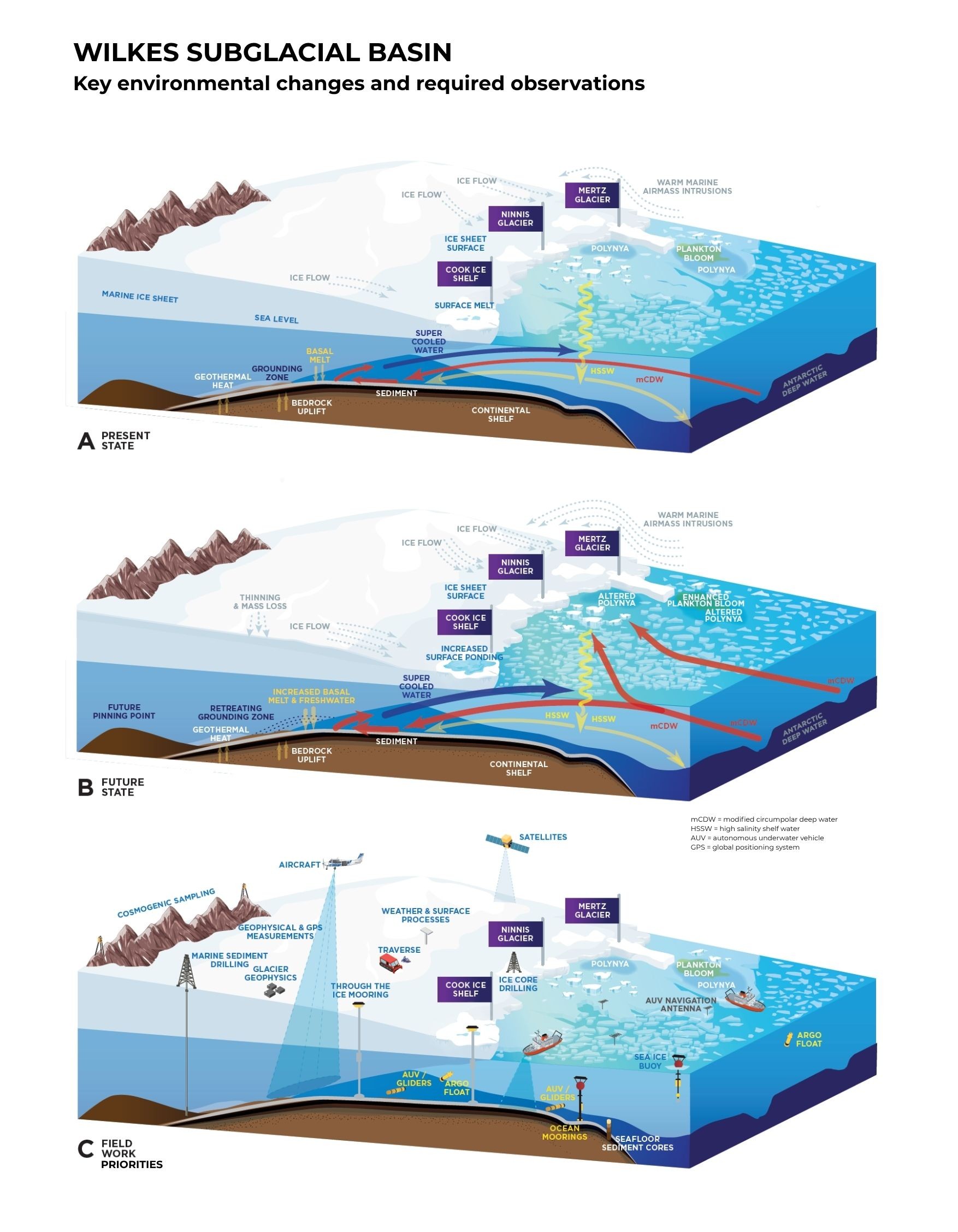
The work was led by the Australian Centre for Excellence in Antarctic Science (ACEAS) in collaboration with the Australian Antarctic Program Partnership (AAPP) and Securing Antarctica’s Environmental Future (SAEF). The research contributes to delivering the Australian Antarctic Science Decadal Strategy 2025–2035.
READ THE PAPER: Dynamic instability of the Wilkes Subglacial Basin Ice Sheet, East Antarctica
FIND OUT MORE: ‘Opening the floodgates: a science briefing about Antarctica and sea-level rise’
READ AN ARTICLE IN THE CONVERSATION: ‘Tragedy stopped Mawson exploring this remote Antarctic region. We must get there to study its melting ice’