Melting from the top: Ice shelf vulnerable to warm surface waters
7 July 2026
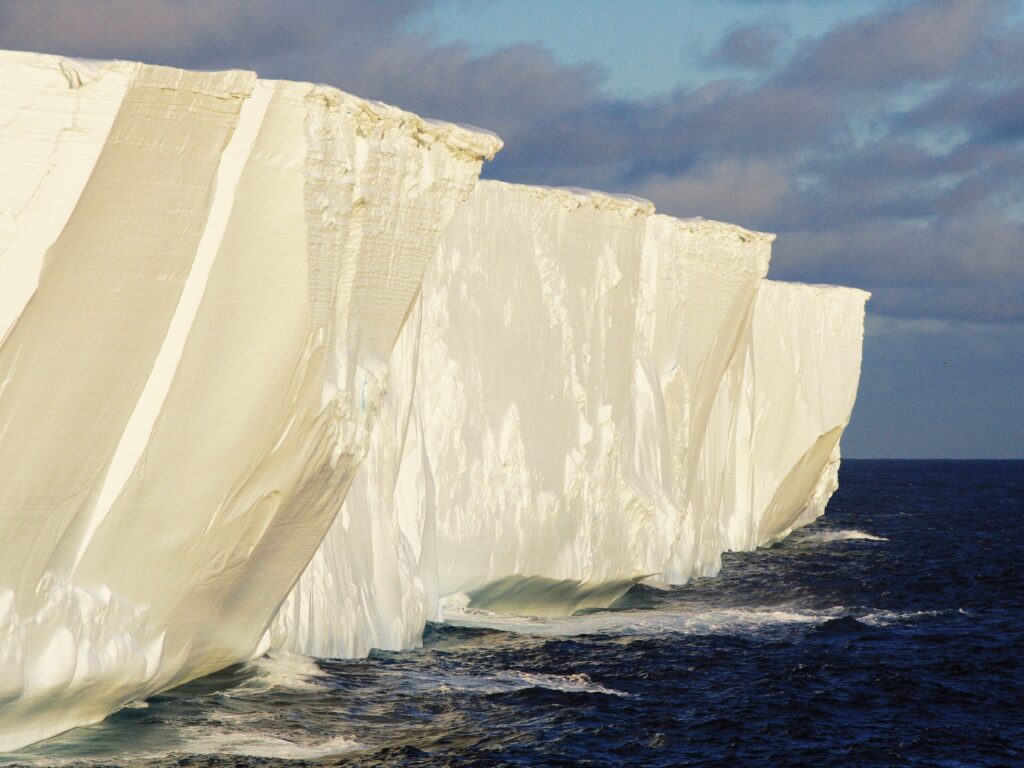
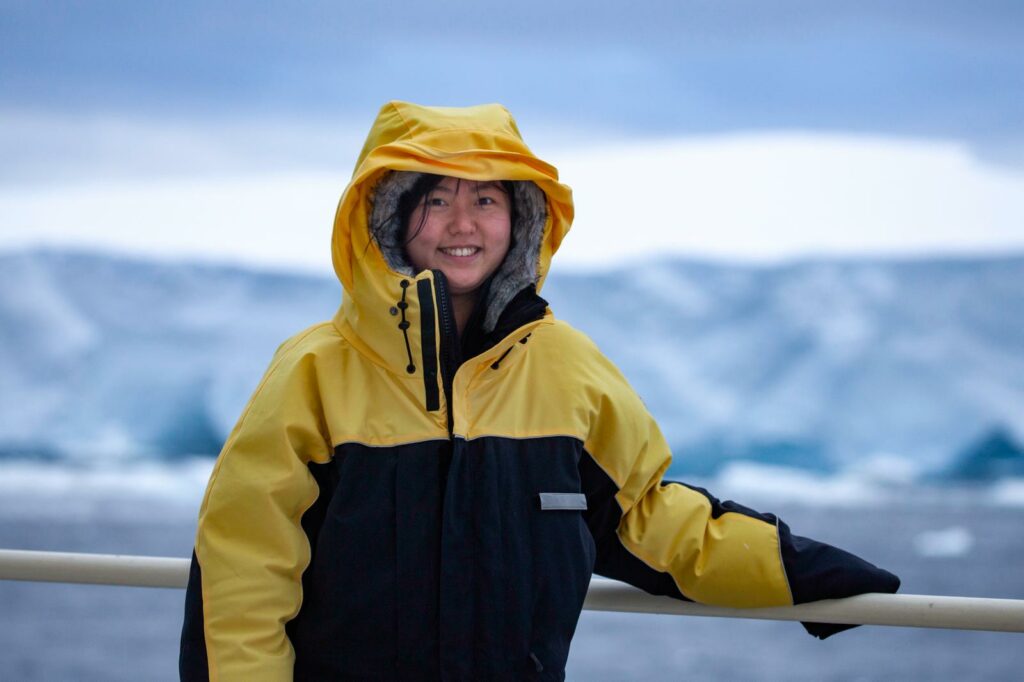
As she watched a surging current shunt icebergs past the Denman Glacier and Shackleton Ice Shelf in East Antarctica, Yuhang Liu recognised where she’d seen it before—in her computer model.
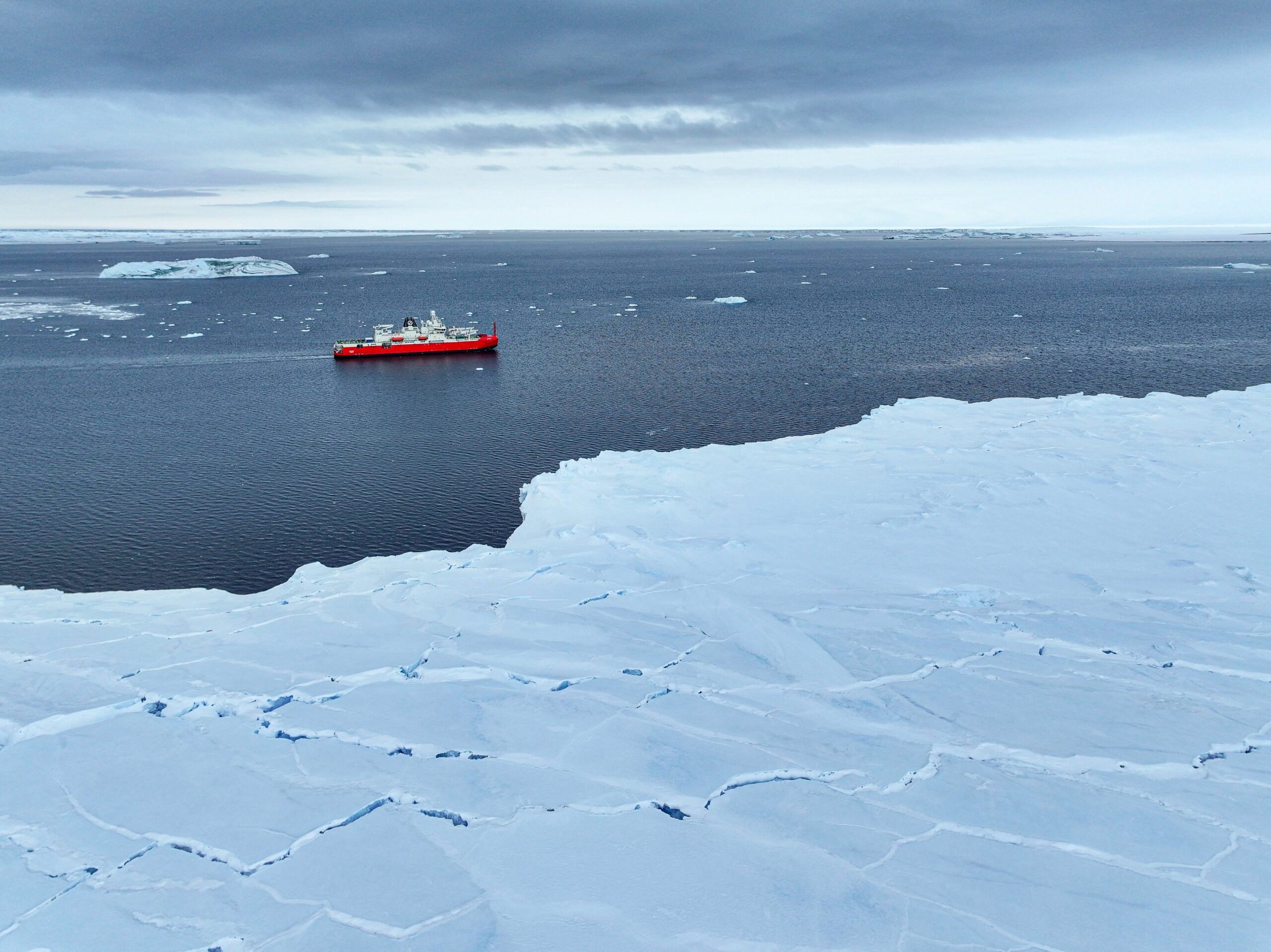
A PhD student with the Australian Antarctic Program Partnership (AAPP) at the University of Tasmania, Yuhang was on board icebreaker RSV Nuyina for the Denman Marine Voyage in 2025, which managed to get within one kilometre of the ice shelf front.
“Near the corner of the ice shelf, where our model predicts the Antarctic Coastal Current flows, we saw large numbers of icebergs being carried rapidly westward—some moving at speeds of more than one metre per second,” she said.
“While the fast-moving icebergs made it too dangerous to collect ocean measurements directly within the current, seeing such a strong current in action was exciting because it supported what the model was showing.”
Using this high-resolution ocean model to simulate the currents, Yuhang led a team of scientists from AAPP and Australia’s national science agency CSIRO in a study that makes an important shift in how we think about ocean-driven melting in East Antarctica.
Their paper ‘Warm surface waters dominate melting of Denman-Shackleton ice-shelf system’ was published in the Journal of Geophysical Research: Oceans in late June.
Shallow melting
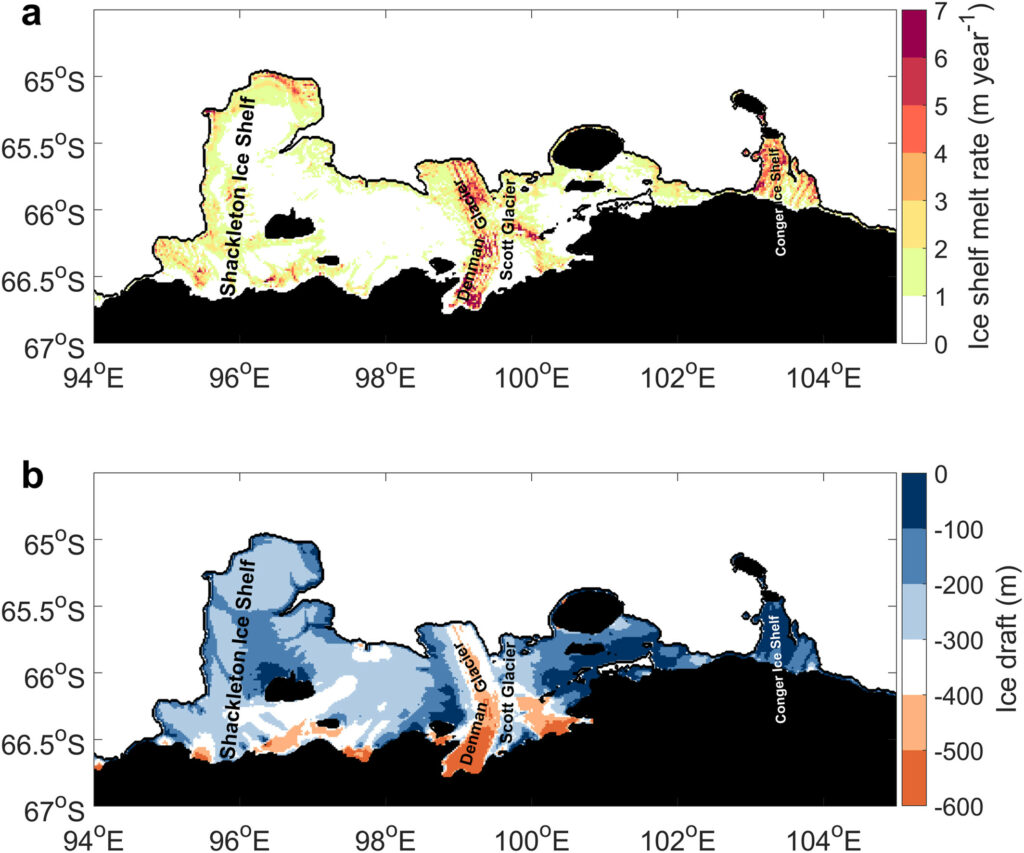
“One of the surprising findings from our research is that most of the melting beneath the Denman-Shackleton Ice Shelf occurs close to the ice shelf front, rather than deep beneath it”, said Yuhang.
“This matters because the front of the ice shelf contains several important ‘pinning points’—areas where the ice shelf is anchored to high points on the seabed, helping to stabilise the entire ice shelf.”
“If shallow melting increases, these pinning points could weaken or be lost, reducing the ice shelf’s ability to slow the flow of glaciers into the ocean, which would ultimately contribute to faster ice loss and sea-level rise.”
“We’ve already seen how vulnerable these shallow ice shelves can be with the collapse of the nearby Conger Ice Shelf in 2022,” she said.
Comes down to geometry
The Denman-Shackleton Ice Shelf is quite unusual because much of its base sits only 100–300 metres below the ocean surface. That means it is exposed to surface waters that warm each summer, rather than the deeper warm ocean water (known as Circumpolar Deep Water, or CDW) that melts many other Antarctic ice shelves.
“Therefore most of the melting happens in shallow water. Significantly, around 80% of the meltwater produced beneath the Denman–Shackleton Ice Shelf comes from shallow melting, rather than melting deep beneath the ice shelf,” said Yuhang.
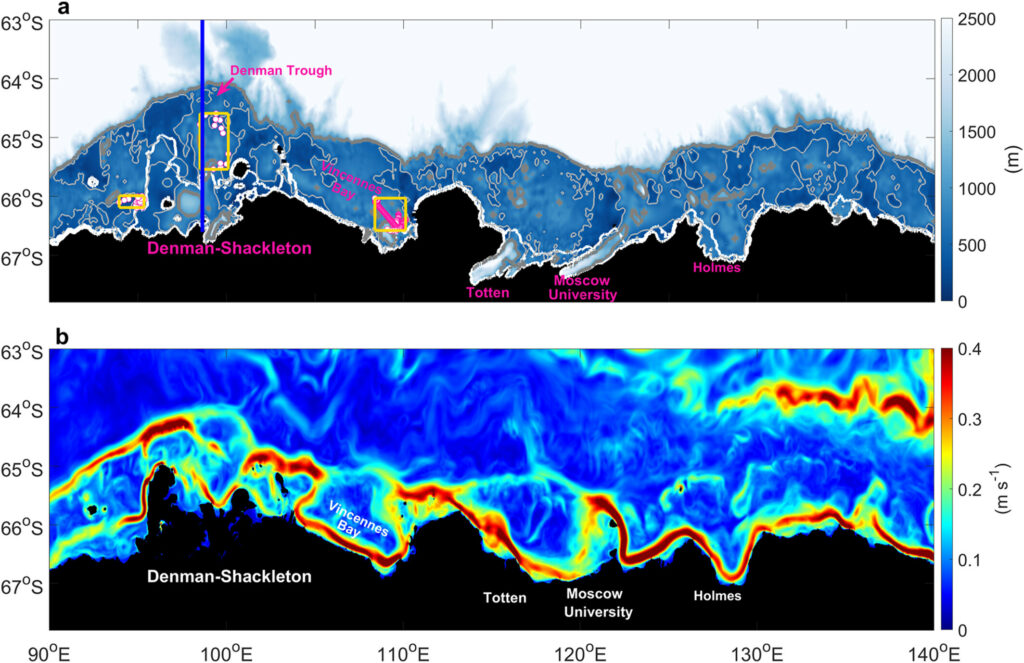
(a) Bathymetry (m) of the full model domain in East Antarctica. Light (thin) and dark (thick) gray contours represent the 450 and 1000 m isobaths, respectively. The white line marks the ice shelf boundary. The circles indicate the positions of the Argo floats. (b) Monthly mean ocean current speed (m) at 100 m depth for April in the final simulation year. Major ice shelves and locations are labeled. (source: JGR:Oceans)
The deep melting mode in this region has been explored in previous observational and modelling studies, with the presence of modified CDW near the Denman-Shackleton ice shelf system confirmed by observations from Argo floats (including one that completed a 300-km-long transect spanning the entire ice shelf), along with oceanographic profiles from water sampling and instrumented elephant seals.
However, the dynamics and drivers of the shallow melting mode, and the role of surface waters in the Antarctic Coastal Current, are less well understood in this region.
“Our study highlights that the geometry of an ice shelf strongly modulates which parts of the ocean contribute to its melting.”
“It also shows that surface waters heated by the atmosphere during summer and driven by winds towards the coast provide most of the heat responsible for melting, instead of warm deep ocean water being the dominant driver,” she said.
Links to sea ice loss
Looking ahead, climate models suggest that warmer surface waters are likely to become increasingly prevalent around Antarctica as sea ice declines, meaning this type of shallow melting could become more widespread in the future.
The lack of sea ice was exactly why the Denman Marine Voyage was able to get closer to the ice shelf front than expected.
With reductions in sea ice cover, more open water absorbs solar and atmospheric heat, surface waters warm, and onshore winds deliver this heat beneath the ice shelf more effectively.
The authors conclude that the Denman–Shackleton system is particularly vulnerable because its dominant melt mechanism depends on processes expected to intensify under climate change.
That’s important because the Denman Glacier is already one of the fastest retreating glaciers in Australian Antarctic Territory. If the Denman were to melt entirely, it alone could contribute around 1.5 metres to global sea level rise.
Yuhang is interested in seeing the observational data collected from CTDs and other instruments during the Denman Marine Voyage to be used in future work alongside computer models.
“The observations collected during the Denman Marine Voyage are incredibly valuable because they help us test and improve models. By comparing model output with real ocean measurements, we can better understand the processes driving ice shelf melting,” she said.
READ THE PAPER: Warm Surface Waters Dominate Melting of the Denman‐Shackleton Ice Shelf System
by Yuhang Liu 1,2 , Maxim Nikurashin 1,2,3 , Beatriz Peña‐Molino 2,4 , Paul Spence 1,2,3,5, and Laura Herraiz‐Borreguero 2,4
1 Institute for Marine and Antarctic Studies, University of Tasmania, Hobart, TAS, Australia,
2 Australian Antarctic Program Partnership, University of Tasmania, Hobart, TAS, Australia,
3 Australian Centre for Excellence in Antarctic Science, Hobart, TAS, Australia,
4 CSIRO Environment, Hobart, TAS, Australia,
5 Australian Centre of Excellence for 21st Century Weather, University of Tasmania, Hobart, TAS, Australia